Pathway to resilience: why adaptation is key to a just transition
Pathway to resilience: why adaptation is key to a just transition
In our latest publication Pathway to Resilience: Our approach to climate change risk and adaptation Craig Love, Director of Impact Assessment and Environment, and Aoife Hutton, Associate of Impact Assessment and Environment outline how we integrate climate risk and adaptation into of the Bank’s portfolio and operations. It also provides details on our adaptation maturity level, touching on the frameworks and tools we use to understand and assess risks.
Climate change is already influencing the way we think about the present and the future, in Scotland and around the world. A string of recent geopolitical developments have added complexity to the path to net zero, meanwhile the risk of unprecedented climate impacts continues to intensify.
The impacts of climate change, increased rainfall, heat stress, supply chain disruption and pressure on essential infrastructure, are no longer distant possibilities. They pose ever-present risks that are monitored and closely analysed by financial institutions, insurers and companies.
To address the risks to Scotland we must prepare not only for the impacts we see now, but also for the more extreme ones we may see in the future. Businesses should not consider emissions reduction (mitigation) in isolation. Instead equal weight must be given to climate change adaptation, alongside mitigation to ensure long-term resilience.
Adaptation is defined as a process of ongoing adjustments in response to observed and projected climate change impacts.
Our adaptation approach
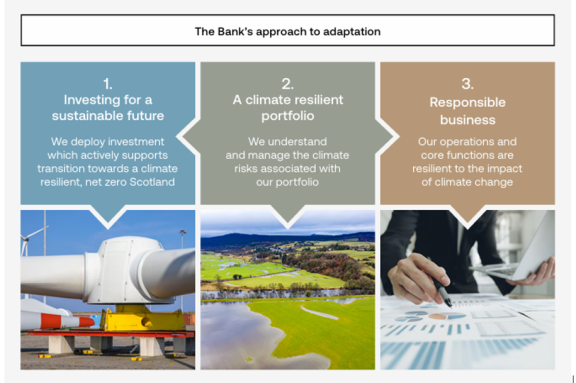
Our adaptation approach is built around three key themes, each designed to strengthen resilience and to enable long-term sustainability. Together, they provide a clear framework to understand climate risks, prioritise action, and integrate adaptation and resilience across our operations and investment decision-making. With these three focal points, we can take a strategic and coordinated approach that supports immediate needs and ensures future climate resilience.
Adaptation and resilience: a strategic investment opportunity
We don’t just view adaptation and resilience as being about managing and reducing climate related risks; both also have the potential to unlock wider benefits for Scotland’s people and economy.
For example, investing in more resilient infrastructure means organisations and communities benefit from better quality services which will withstand the physical impacts of climate change.
Effective adaptation also supports healthier, safer and more equitable communities by reducing vulnerability and improving wellbeing, while helping to build stronger, more reliable supply chains capable of absorbing shocks and disruptions.
Ultimately, investing in adaptation contributes to Scotland’s long‑term economic stability by protecting assets, reducing future costs and creating the conditions for sustainable growth.
Our adaptation benchmark
As Scotland’s national development bank, it is important to hold ourselves to the highest standards possible when it comes to climate change adaptation. Undertaking a workshop using Adaptation Scotland’s Capability Framework, we found that the Bank currently operates at an intermediate to advanced level in several areas, particularly in how we understand climate risk, how we embed climate considerations into our organisational culture and how we collaborate across teams.
While these ratings are a reflection of the important work already done at the Bank, the assessment highlighted that our maturity on planning, implementation and monitoring is at an earlier “starting” stage.
This rating should not be seen as a reflection of weakness across our processes. Rather, the assessment highlighted key areas to implement a more formalised, structured approach in relation to adaptation.
Collective action required for a well-adapted and resilient Scotland
Climate change adaptation, resilience and mitigation can no longer be viewed in isolation, as each are essential to delivering a just and sustainable transition.
By building strong foundations now across governance, investment decision-making and organisational culture, the Bank is working hard not only to support Scotland’s net zero goal but also ensure its communities remain resilient and benefit from new opportunities amidst a changing climate.
By Craig Love, Director of Impact Assessment and Environment at the Scottish National Investment Bank and Aoife Hutton, Associate of Impact Assessment and Environment at the Scottish National Investment Bank